
Digital video file formats

There are at present 2 categories of video ...
- SD (standard definition) - which uses technologies such as Freeview TV broadcast, miniDV camcorders and DVD video discs.
- HD (high definition) - which uses technologies such as HD satellite and cable broadcast, iTunes, and Blu-Ray discs.
If you have not already done so, you may wish to read our article on Codecs, formats and optimising concepts before continuing.
Digital video formats
There are many many digital video formats in the consumer and professional worlds. For example, all of the following can record and/or playback some form of digital video ...
- Computer
- DVD video disc
- DVD ROM
- CD ROM
- Cable TV
- Satellite TV
- DV camcorder
- Games console
- Video mobile phone
But they do NOT all use the same data file formats.
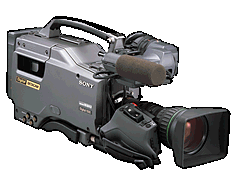
Sony DigiBeta camcorder
Compressed and uncompressed video formats
The data rate produced by the lens and CCD system of a digital video camera/camcorder can be huge. Therefore it is common for "lower" priced video systems to reduce or compress video data to more manageable file sizes.
Uncompressed video formats
Uncompressed video has the potential for the greatest quality but can be very large. There are a number of professional broadcast quality uncompressed digital video formats including Sony DigiBeta and Arri, but these require specialist hardware and software. Standard Macs and PCs are not powerful enough. DigiBeta, and formats like it, are used to film TV programmes such as news, reality TV, soaps and game shows etc. One edited the files are compressed for broadcast/delivery systems.
Compressed video formats
What is a codec?
To reduce file size in order to help storage, processing, editing and transferring systems, most video formats involve the use of compression software at the point of capture/filming. After editing, the video may be further compressed more "aggressively" when being prepared for publishing. The compression software is called a codec (more here).
Compressed video file and data formats are often identified by the codec they employ. A codec will ...
- compress the data inside a camera/camcorder as soon as the data leaves the CCD (which converts light into binary) and before storing it, and then later de-compress it for viewing and editing
- further compress video files ready for broadcast and delivery (cable, satellite, DVD etc), once the edit is complete
Processes that involve codecs include ...
- recording/filming to the video tape in a camcorder
- storage on the hard disc of a computer
- burning a DVD
- transmission over the internet
- broadcast via satellite or cable
- transfer to a portable device (eg iPod or mobile phone)
- replay of video
2 types of video compression
There are many different open source and commercially licensed codecs but most fall into one of two categories ...
- Intraframe (i-frame). Each frame is treated like a still image and compressed using a codec such as JPeg or Red's Redcode.
- Interframe. At a pre-determined interval a keyframe is fully recorded and then subsequent frames are compared to it. Only the differences in these subsequent frames are recorded. MPeg compression employs this process.
Quality & file size
The more video is compressed ...
- The smaller the file size (easier to store and transfer)
- The lower the data rate (easier to replay and stream)
- The worse the quality
The compression settings you choose when preparing video will depend upon ...
- The CPU power of the target computer (which will need to compress, decompress and display video files).
- The duration of the video
- The capacity of the media it will be stored on (floppy, CDROM, DVDROM etc?).
- The bandwidth of the connection (if on a web site)
Where can video codecs be located??
Video codecs may be located in several places ...
- Camcorders and cameras have "hard codec" chips
- Computer system folders (so called "soft codecs" such as the ones that QuickTime and Windows Media Player provide)
- Browser plug-ins (usually utilise system installed soft codecs
- Video PCI expansion cards often have "hard codec" chips similar to those found in DV camcorders
- DVD players have "hard codec" chips to decompress the MPEG-2 video files that DVD discs carry
- Set top boxes for satellite and cable TV
- Games consoles
- Mobile phones
- iPod's
Because a camcorder/camera is where video is first captured and compressed, the codecs they use often determine the codec used throughout the complete edit. There is a comprehensive round-up of current camcorder and codec technologies here.
Standard definition
Standard definition is basically anything that isn't HD and includes DV, MPeg 1 and lower resolutions of MPeg 2.
The most popular semi-pro and amateur SD video production format is DV. Read about the DV format here and by viewing our PDF on DV Signal Flow.
Incidentally, audio CDs do not use codecs because the data size of digital audio files is small enough to fit on a CD without being compressed. MP3 audio however, is highly compressed. Click here for an article on digital audio file formats.
HD (hi-definition)
High definition video has "splintered" into many differing file formats, such as AVCHD. More on hi-def is here.
Example file formats & codecs
Unlike the world of digital audio, where 2 uncompressed file formats (.wav, .aif ) and 1 compressed file format (MP3) dominate, digital video is a minefield.
NOTE: You may wish to read an explanation of the difference between file formats and codecs before you continue reading.
Here are SOME of the digital video data file and codec formats ...
| Data file type | Codec(s) | Filming / Camcorder? | Editing? |
Delivery? |
|---|---|---|---|---|
| DV | DV codec | Yes | PC & Mac editing | No, must be converted first |
| MPEG-1 | MPEG-1 | No | No | CD ROM & web |
| MPEG-2 (SD DVD, digital, cable & satellite TV) | MPEG-2 | Yes | No | Satellite & cable TV broadcast, HDV and DVD video discs |
| AVCHD | MPeg-4/H.264 | Yes | Yes | YouTube, HTML5 (some browsers) |
| QuickTime (.mov) | Multiple | Some | Yes | QuickTime Player |
| - | Sorenson | No | No | CDROM, DVDROM, web |
| MPEG-4 | Includes many codec variants including H.264 | Yes | Yes | Everything ... from HD DVD, digital TV to mobile phones, PSP, iPod etc |
| divX | Appears to use an MPEG-4 variant codec | No | No | CDROM, DVDROM, web |
| - | xVid | No | No | CDROM, DVDROM, web |
| - | 3GPP | No | No | Mobile phones |
| Windows Media (.wmv) | Multiple | No | Yes | Windows Media Player |
| Flash (.swf) | On2 VP6, MPEG-4/H264, WebM | - | - | Flash player, HTML 5 (some browsers) |
| Ogg Theora | On2 VP3.2 | No | No | HTML 5 (some browsers) |
| WebM | On2 VP8 and Ogg Vorbis | No | No | Google owned open source format for web. Not yet universally supported by all browser developers |
| Hi-Def: For a comprehensive round-up of hi-def camcorders & codecs click here. | ||||
Because a camcorder/camera is where video is first captured and compressed, the codecs they use often determine the codec used throughout the complete edit. There is a comprehensive round-up of current camcorder and codec technologies here.
Further reading
Video format and media player software
Related downloads
None at present
Featured artist
